Chapter 4.4 follows chapter 4.3, The purpose and rules of each dose, and precedes chapter 4.5, Measurement of the dose, within part 4, the profile library.
4.4.1 Strip operation of the documentation profiles
The strip, the program that removes the documentation layer from a tree, derives a stripped twin from each documented build. It copies the documented tree to a destination and applies the removal rules there. The source tree remains available for comparison. The operation is mechanical and deterministic. source: operations/site-ia/A6-page-briefs.md line 652
The strip reads 5. Experiment/3. LAP Profile Library/L1-orientation-only/artifact_rules.md in each profile folder. Those rules identify documentation artifacts. The layered artifact profile (LAP) manifest is also read from the lap_artifact_manifest.json file under each .../variants/H-LAP-*/ path. The manifest key strip_order supplies the removal sequence. The strip removes comments and docstrings from Python files through syntax-aware processing. It removes documentation-only files named by the manifest. Functional files remain in the destination.
source: operations/site-ia/A6-page-briefs.md line 656
The owning implementation is 5. Experiment/1. Harness/scripts/strip_lap.py. The related preparation files are 5. Experiment/1. Harness/scripts/instrument_profile.py and 5. Experiment/1. Harness/scripts/materialize_feature_bases.py. The profile rules and manifests specify what is removed. The strip script applies those rules and records the result.
source: operations/site-ia/A6-page-briefs.md line 656
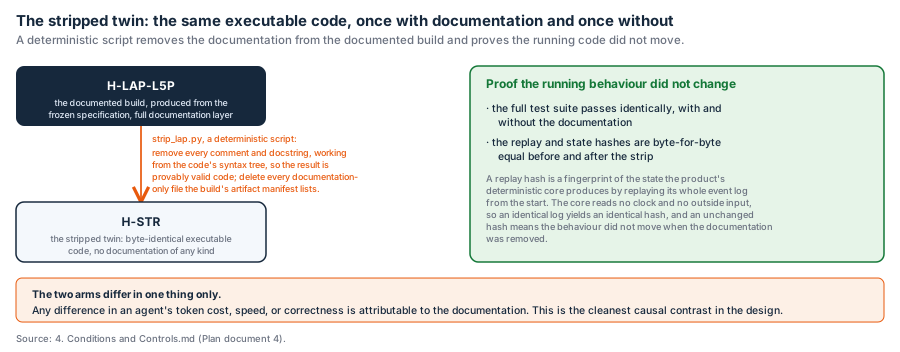 D-L3-3. The documented tree and its stripped twin, with the documentation layer removed.
source: 5. Experiment/0. Plan/3. The LAP Profiles.md line 287
D-L3-3. The documented tree and its stripped twin, with the documentation layer removed.
source: 5. Experiment/0. Plan/3. The LAP Profiles.md line 287
4.4.2 Artifact removals of the documentation profiles
The removal has two physical forms. Python files retain their executable statements while comments and docstrings are removed. Documentation-only files are absent from the stripped twin. Files that carry executable or operational content remain. This distinction gives the documented tree and the stripped twin different file contents and different documentation inventory while preserving the code under comparison.
The profile rules and the manifest are the authority for documentation-only files. The strip reads the manifest before deletion and follows strip_order. The fixed order makes the operation reproducible across profile folders. The report records processed files and removed files. It also records before and after hashes.
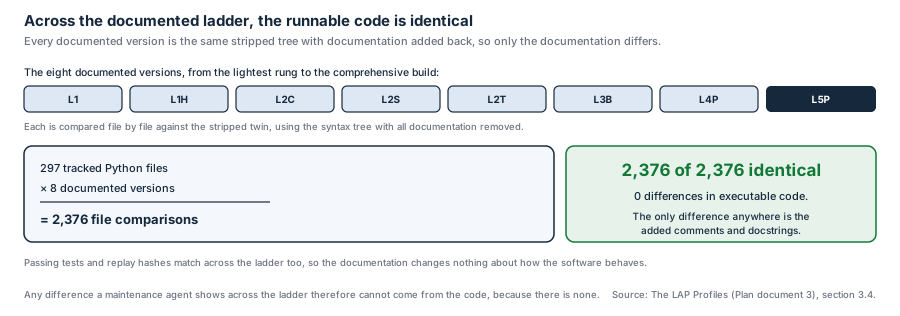 D-L3-1. Byte identity for executable code across a documented file and its stripped twin.
source: 5. Experiment/0. Plan/3. The LAP Profiles.md line 287
D-L3-1. Byte identity for executable code across a documented file and its stripped twin.
source: 5. Experiment/0. Plan/3. The LAP Profiles.md line 287
4.4.3 Strip order of the documentation profiles
The strip_order key provides a sequence for artifact removal. The sequence begins with the manifest-guided documentation inventory and continues through the listed documentation-only artifacts. Python source processing follows the same declared operation. The report is written after the removal work, so its file inventory describes the completed transformation.
The order is stored in each file listing the files for one build. It is applied by 5. Experiment/1. Harness/scripts/strip_lap.py. The orientation-only profile rules explain the kinds of files that receive the same removal treatment in that order. The order is part of the reproducible transformation from a documented build to a stripped twin.
source: operations/site-ia/A6-page-briefs.md line 656
Figure fig-strip-order. The ordered strip sequence from profile rules and the artifact manifest through Python processing, documentation-only file removal, and report creation
%% figure fig-strip-order
flowchart LR
  n1["The ordered strip sequence from profile rules and the artifact manifest<br/>Python processing<br/>documentation-only file removal<br/>report creation"]
source: operations/site-ia/A3-diagram-specification.md
D-L3-4. The strip order from profile rules through report creation.
source: operations/site-ia/A6-page-briefs.md line 660
4.4.4 Byte identity of the documentation profiles
The stripped twin is derived from the documented build. It is not compiled as an independent implementation. The comparison therefore asks whether executable bytes change during removal. The strip script hashes each Python file before and after processing. Equal hashes establish byte identity for files whose executable content is preserved. The recorded file inventory establishes which documentation artifacts disappeared.
The experiment tracked 297 Python files in this comparison. source: 5. Experiment/0. Plan/3. The LAP Profiles.md line 287
It made 2,376 file comparisons across the documented trees and stripped twins. source: 5. Experiment/0. Plan/3. The LAP Profiles.md line 287
The as-built note in the profile document records these totals. The same profile document supplies the stated construction of the documented builds. The identity check uses the strip report and the before and after hashes rather than a visual inspection. source: operations/site-ia/A6-page-briefs.md line 656
4.4.5 Inertness evidence of the documentation profiles
The documentation layer is inert with respect to executable behavior. 5. Experiment/1. Harness/scripts/instrument_profile.py and 5. Experiment/1. Harness/scripts/materialize_feature_bases.py provide the preparation and materialization steps used for the inertness figures. The strip removes documentation artifacts while preserving the executable material. The comparison of file hashes and replay outputs checks that removal does not alter the running code.
source: operations/site-ia/A6-page-briefs.md line 656
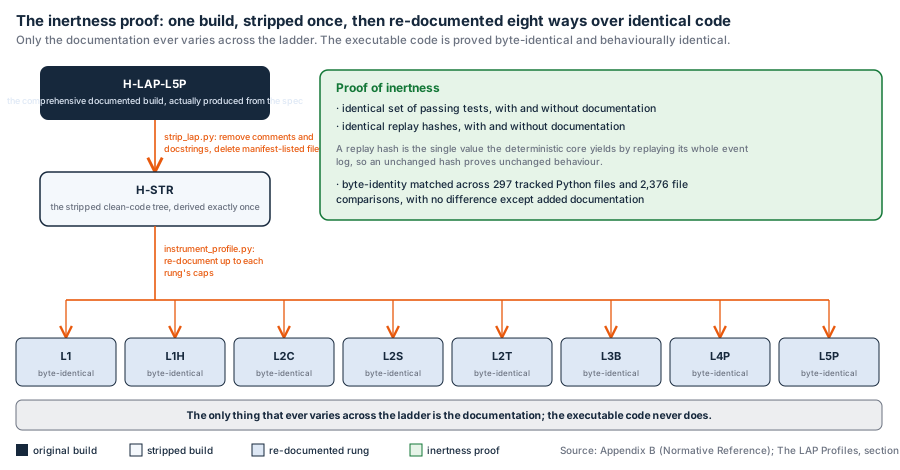 D-L3-2. The extra inertness proof for the stripped twin.
source: 5. Experiment/0. Plan/3. The LAP Profiles.md line 287
D-L3-2. The extra inertness proof for the stripped twin.
source: 5. Experiment/0. Plan/3. The LAP Profiles.md line 287
The identity claim has two parts. The file comparison checks bytes in the Python files. The execution comparison checks the resulting behavior. Together they show that the documented build and the stripped twin differ in documentation material while sharing the executable basis used by the experiment.
Adjacent-page controls, links between neighboring pages, connect the pages in sequence.
4.4.6 Source records of the documentation profiles
The source record for the strip rules is the orientation-only profile folder’s artifact rules file. The implementation record is 5. Experiment/1. Harness/scripts/strip_lap.py. The manifest record is the strip_order key in each file listing the files for a build. The profile record is the profile document, including its as-built note. These records connect the physical removals with the comparison totals and identity evidence.
source: operations/site-ia/A6-page-briefs.md line 656
Measurement is the process of determining a quantity.
Previous and next navigation, links that move between adjacent pages, is provided by the adjacent-page controls.
source: operations/site-ia/A6-page-briefs.md line 650