Chapter 1.4 follows chapter 1.3, The measuring instrument, and precedes chapter 1.5, Measurement of one cell, within part 1, the reading path.
The treatment is a documentation layer inside the codebase. Its underlying code is byte-identical across the documentation ladder. The byte-identity figures belong to the third ladder entry and the construction entry. The ladder is read with the profile library of documentation doses and the construction and freezing of the builds as its companion entries. source: operations/site-ia/A6-page-briefs.md section R3., owning files
The documentation level and build form describe the same codebase. An arm, one of the codebase versions under comparison, is an experimental group. A rung, one position on the documentation ladder, adds a defined collection of artifacts under the cumulative-nesting rule.
1.4.1 Documentation ladder of the documentation experiment
The experiment has eight rungs: L1, L1H, L2C, L2S, L2T, L3B, L4P, and L5P. A payload, the measured documentation carried by a rung, is reported in billed tokens and as a share of the source. Each higher rung retains the artifact kinds used below it while adding its own documentation layer. Every rung is produced as a fresh instrumentation pass over the same clean code, rather than by editing the preceding rung. source: operations/site-ia/A6-page-briefs.md section R3., owning files and section 1
The payload of each rung is as follows.
678 tokens and 0.228 percent for L1 source: Appendix B, Normative Reference.md section (c), table at lines 97 to 104
4,399 tokens and 1.479 percent for L1H source: Appendix B, Normative Reference.md section (c), table at lines 97 to 104
5,782 tokens and 1.944 percent for L2C source: Appendix B, Normative Reference.md section (c), table at lines 97 to 104
8,018 tokens and 2.696 percent for L2S source: Appendix B, Normative Reference.md section (c), table at lines 97 to 104
10,749 tokens and 3.615 percent for L2T source: Appendix B, Normative Reference.md section (c), table at lines 97 to 104
11,876 tokens and 3.994 percent for L3B source: Appendix B, Normative Reference.md section (c), table at lines 97 to 104
25,057 tokens and 8.427 percent for L4P, over its 7.0 percent soft target source: Appendix B, Normative Reference.md section (c), table at lines 97 to 104
43,683 tokens and 14.690 percent for L5P source: Appendix B, Normative Reference.md section (c), table at lines 97 to 104
The shared denominator is 976,116 characters or 297,357 tokens. source: Appendix B, Normative Reference.md line 91
The measurement date is 2026-08-06. source: 3. LAP Profile Library/api_reported_measurement_2026-08-06.json key date
Rung L1H has 297 module headers. source: 3. The LAP Profiles.md line 110
The index, a map of the available documentation and its lookup paths, is included from L2S upward and omitted from the lighter rungs so its separate contribution can be measured. A strip is a variant with its documentation removed and produces the stripped comparison form. The code beneath the layer remains byte-identical; the supporting proof is reported in L3 and P4. source: operations/site-ia/A6-page-briefs.md section R3., owning files
Figure D-L0-1. The eight documentation doses in ladder order and the measured payload of each
%% figure D-L0-1
flowchart TB
  subgraph ladder["Ladder"]
  n1_1["step"] --> n1_2["0. Plan/Appendix B, Normative Reference.md"]
  n1_2 --> n1_3["payload_budget.json"]
  n1_3 --> n1_4["AGENT_CONTEXT.md"]
  end
  subgraph measurement["Measurement"]
  n2_1["traceability.json"] --> n2_2["LAP_LEVELS_GUIDE.md"]
  n2_2 --> n2_3["3. LAP Profile Library/api_reported_measurement_2026-08-06.json"]
  n2_3 --> n2_4["rungs"]
  n3_1["api_reported_tokens"] --> n3_2["payload_chars_uniform_basis"]
  n3_2 --> n3_3["H-STR"]
  n3_3 --> n3_4["source_basis"]
  n4_1["measurement_policy.md"] --> n4_2["1. Harness/scripts/instrument_profile.py"]
  n4_2 --> n4_3["compute_payload_pct()"]
  n4_3 --> n4_4["check_payload()"]
  n5_1["run_gate()"] --> n5_2["lap_profile_index.csv"]
  n5_2 --> n5_3["lap_profile_id"]
  n5_3 --> n5_4["payload_target"]
  n6_1["payload_pct_chars"] --> n6_2["relationship_edges"]
  n6_2 --> n6_3["decision_notes_per_kloc"]
  n6_3 --> n6_4["variant_built"]
  n1_4 --> n2_1
  n2_4 --> n3_1
  n3_4 --> n4_1
  n4_4 --> n5_1
  n5_4 --> n6_1
  n1_1 -- "3. LAP Profile Library/LAP_LEVELS_GUIDE.md" --> n1_1_reference["reference"]
  end
source: operations/site-ia/A3-diagram-specification.md
source: operations/site-ia/A6-page-briefs.md section R3., diagrams
The ladder stills shared with the profile-library entry.
1.4.2 Artifact anatomy of the documentation experiment
An artifact, a piece of documentation written into the codebase, can be an orientation file, a trace anchor, a trace file, a decision note, a relationship map, or a manual. The entry-point index, a compact map of the available documentation and its lookup paths, gives an agent a starting place. These artifacts carry information for maintenance while leaving program behaviour unchanged.
A trace file is a machine-readable record that connects requirements and invariants to the files and functions that implement them. The entry-point index points to this file and to the other available documentation. The anatomy is shared with L1. source: operations/site-ia/A6-page-briefs.md section R3., diagrams
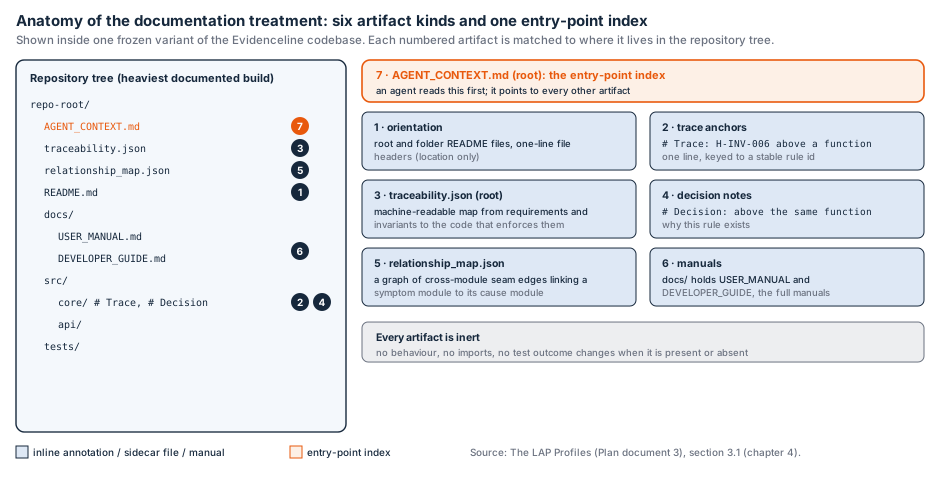
The anatomy of the documentation layer and its entry-point index, shared with L1. source: operations/site-ia/A6-page-briefs.md section R3., diagrams
1.4.3 Entry-point index of the documentation experiment
The entry-point index is read before wider repository searches. It names the available documentation, its keys, and the least costly way to query each source. Its placement is part of the ladder design, so its contribution can be distinguished from the contribution of documentation volume.
1.4.4 Documentation upkeep of the documentation experiment
Upkeep, the duty to keep documentation current with changed code, is part of the treatment. The maintenance prompt requires the agent to update documentation already kept for the parts it changes. The agent follows the existing conventions and level of detail. It does not create documentation where the repository has none.
The build and instrumentation method (HASP) generates and documents variants and carries this requirement into the protocol. The same upkeep rule applies across the documented, stripped, and control variants.
A handoff note, a structured record of work for the next worker, records changed files, new calls, routes, identifiers, conventions, and data shapes. The agent leaves this record in the final message and in the required structured handoff file.
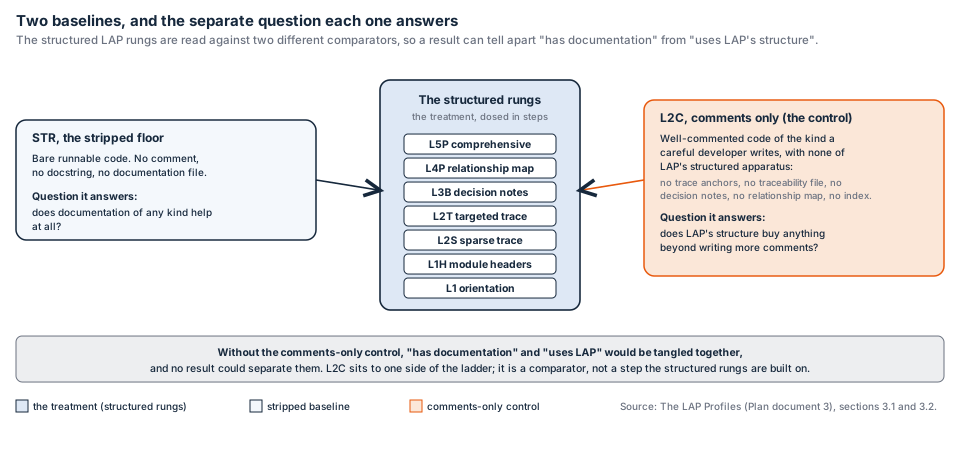
The documentation ladder, comparison forms, and maintenance path.
1.4.5 Tree freeze of the documentation experiment
The trees are frozen before any cell runs. The freeze fixes the code, the documentation variant, the stripped form, and the control used for measurement. The construction record belongs to the construction entry, while this entry records the documentation layer that the frozen variants carry. source: operations/site-ia/A6-page-briefs.md section R3., owning files
source: operations/site-ia/A6-page-briefs.md section R3.