Chapter 5.7 follows chapter 5.6, Scoring of a cell, and precedes chapter 5.8, The witness and the verification records, within part 5, the task library.
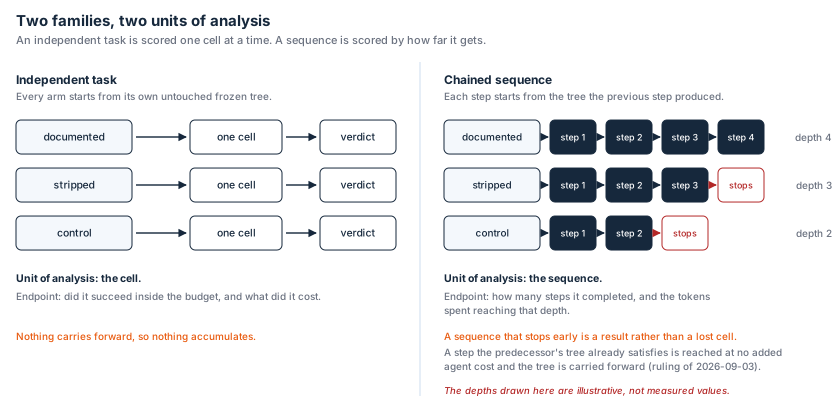
The maintenance suite contains independent work and chained work. A chained sequence carries the tree produced by one step into the next step. It stops when a step fails, and its depth outcome records the furthest successful point. The suite uses chained sequences, predecessor trees, and depth outcomes in their established senses.
5.7.1 Two sequence structures of the maintenance-task suite
The harness names two chains, H-M029 to H-M032 and H-M033 to H-M036. source: 1. Harness/scripts/task_sequences.py line 12
The work-item checklist chain contains H-M029, H-M030, H-M031 and H-M032. Its steps add the checklist, its progress summary, its completion guard and its history. Each step relies on the predecessor tree supplied by the preceding step. source: 4. Task Library/Project H/SEQUENCE-1-work-item-checklist.md lines 9 to 12 source: 4. Task Library/Project H/SEQUENCE-1-work-item-checklist.md line 16 source: 4. Task Library/Project H/SEQUENCE-1-work-item-checklist.md line 22
The mention-notifications chain contains H-M033, H-M034, H-M035 and H-M036. Each step relies on the predecessor tree supplied by the preceding step. source: 4. Task Library/Project H/SEQUENCE-2-mention-notifications.md lines 9 to 12
The two chained task families and their ordered work items.
5.7.2 Sequence depth outcome of the maintenance-task suite
A step starts from the tree produced by its predecessor. A successful step hands that tree, together with its own changes, to the next step. A failed step ends the sequence for that arm. The resulting depth records how far the arm reached and distinguishes partial progress from completion.
The harness maps each task to its ordered chain. It rejects loops and ambiguous successor declarations. The batch tests stage a later step from its predecessor workspace, stop the remaining steps after failure, and keep other arms of the chain independent. A task outside a chain receives no predecessor tree.
5.7.3 Fourth-step shortcut of the maintenance-task suite
An early shortcut can satisfy the visible and hidden checks for several steps while omitting structure needed later. The omitted structure travels inside the predecessor tree. When a later step finally requires it, the chain stops at that point and the earlier successful depth remains recorded.
In the work-item checklist chain, a single mutable field can support the earlier checklist behaviour while losing the history of changes. The history step then needs a record that the earlier implementation did not retain. In the mention-notifications chain, a read flag can support current read status while losing the time of the read. A later request for a past unread set then exposes the missing record.
source: 4. Task Library/Project H/SEQUENCE-1-work-item-checklist.md line 28
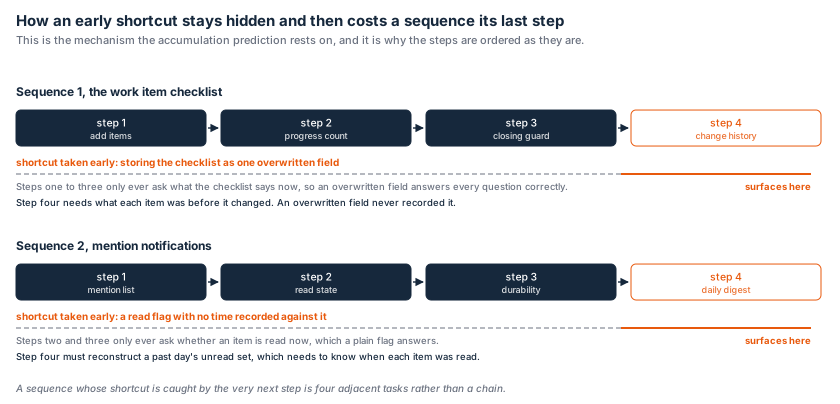
The accumulation of an early shortcut across a chained sequence.
5.7.4 Chained-step handover of the maintenance-task suite
A chained step may already be satisfied by the predecessor tree. The task file states what the step relies on, so the handed tree can contain the requested behaviour before the next agent works. The staging gate checks the handed tree. When those checks pass there, the step is recorded as reached at zero agent cost, the tree is carried forward, and the sequence continues.
The baseline for a chained step check is the tree from which the whole chain began. The scorer and the staging gate use that baseline. The check therefore sees the changes accumulated by the chain, including surfaces supplied by predecessors, while the result remains tied to the behaviour requested by the current step. A zero-cost handover contributes depth without adding agent cost.
source: 4. Task Library/PROBE_AUTHORING.md line 100
source: 4. Task Library/Project H/SEQUENCE-1-work-item-checklist.md line 36
Figure task-handover-flow. A predecessor step hands its produced tree to the next step, whose staging gate checks the handed tree. A passing check records a zero-cost reached step and continues the chain, while a failing check admits the agent and compares the finished tree with the chain baseline.
%% figure task-handover-flow
flowchart TB
  subgraph g1[" "]
    n1["A predecessor step hands its produced tree to the next step<br/>whose staging gate checks the handed tree. A passing check records a zero-cost reached step and continues the chain<br/>while a failing check admits the agent and compares the finished tree with the chain baseline"]
  end
source: operations/site-ia/A3-diagram-specification.md
The handover path for a chained step.
5.7.5 Missed-work incidents of the maintenance-task suite
One incident involved a step whose requested behaviour was already present in the predecessor tree. The staging gate treated passing checks on that handed tree as a refusal of the cell. The sequence stopped, so the correct predecessor work was recorded as missed. The handover rule corrects this by recording the step as reached at zero cost and carrying the tree onward.
A separate incident involved a chained check using the handed predecessor tree as its baseline. The predecessor surface was then present in both the baseline and the finished tree, so a difference-based check discarded it as pre-existing. The check missed correct work and the sequence lost the corresponding measurement. The whole-chain starting tree supplies the baseline, making the accumulated predecessor surface visible to the check while keeping the current step’s requested behaviour as its subject.
Figure task-incidents-missed-work. The two missed-work incidents show a staging-gate refusal in one path and a handed-tree baseline comparison in the other, followed by the handover and whole-chain baseline corrections.
%% figure task-incidents-missed-work
flowchart TB
  subgraph g1[" "]
    n1["The two missed-work incidents show a staging-gate refusal in one path and a handed-tree baseline comparison in the other<br/>followed by the handover and whole-chain baseline corrections"]
  end
source: operations/site-ia/A3-diagram-specification.md
The two incidents in which chained checks missed correct work.
The witness, an honest implementation kept on the host side to prove that a check set is passable, supports these records.
Verification records, files that preserve checks and their results, support review of the work.